I usually get sick at least once a semester. I was surprised that I've gone about four months without catching anything. Well, sadly I missed two days this week because of a sore throat. I actually tried to go to work today and my supervisor sent me home to rest.
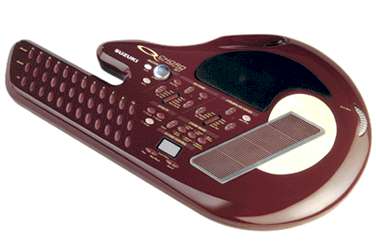
With the extra time on my hands I went through the manual and learned all about the Q-chord. I already knew the basics and used the Q-chord once during procedural support with an older patient. The patient had very high anxiety and the Q-chord helped promote relaxation. Sometimes the guitar can be a barrier and having alternate interventions in your bag can make you stronger as a therapist. In a future blog (and once I feel better) I will reflect on how the Q-chord and skills I learned this week benefited me in future sessions. I might just post a video tutorial on the basics of the Q-chord, so stay tuned!
Friday, September 9, 2011
Thursday, September 8, 2011
New Way of Thinking
My supervisor has helped me look at music therapy in a whole new way. When I go into a room I have to explain how what I did is different than a volunteer. Everything I do in a session must have a purpose. So the answer to patients or staff in the hall who ask us, "Oh, do you just play music for patients?" Is of course no. Or it can be bothersome when some people ask us if we are volunteers. We have to explain to inquirers that no, we don't just play music. When we have the time we go in depth of what we do and how it is different than a volunteer. It is tough when I get asked "Do you play music to patients?" I say, "Yes" because technically I do but it's much more than that.
At the hospital we have a lot of nursing students learning from the staff and doing case studies with the patients. It can be overwhelming with the amount of people at the nursing station. The other day I was in a room during a session and they asked that same question. I took the time to educate them about music therapy and the importance of it. It was refreshing that I could explain this concept to them because I remember one day when it wasn't so easy.
One exercise my supervisor had me do is write out two definitions for music therapy. One is written for staff using their language. Another is for patients/family with understandable terms. It's good to plan what to say beforehand so you sound confident and articulate in what you do.
Monday, September 5, 2011
Being Attentive
One skill I'm learning is to be attentive. Last week, I overheard an IV start was about to commence and I approached the nurse and said "I would love to help." Nurses don't always refer music therapy for a procedure so when I am on a unit I make sure to keep my ears peeled. IV starts happen almost every time the hospital receives a new patient. So I can see why nurses don't refer music therapy unless their patient seems to have high anxiety.
I have also learned how to advocate for music therapy on my first rotation. I gave my pager number to the secretary, built rapport with staff, and posted a flyer introducing myself on the unit. Now I can implement my knowledge sooner on the next unit. I am currently working only on the general pediatric unit and will soon transition to the pediatric surgical unit. After my rotation on each unit I will be in charge of the entire hospital for two weeks.
Saturday, August 27, 2011
Midterm Evaluation
This week I completed my midterm evaluation! I can not believe I'm half way done. Time is starting to fly a little more each week. After my midterm, my supervisor commented on how much my music has improved. It was a nice time to reflect on how much I've grown as a therapist and has helped build my confidence for the final advance to the finish line.
Sunday, August 14, 2011
The Path from Student to Professional
The path from student to professional is very unique to every music therapy student. I was on the same path as my fellow peers in my music therapy sequence while at FSU. I didn't really have to think much about it, if I had a question I asked my friends what they did for a course or an assignment. But here we are at the part of the path where we need to decide what internship to apply for, job to take, and population to work with. The scary part is we have to leave our peers behind and walk down the next part of the path alone. I knew I wouldn't be completely alone but metaphorically speaking, alone.
When I was at regional conference and a professional covered this topic, I was scared. I knew others were scared too when someone asked "What if I don't get an internship?" I personally felt like I was entering into some sort of limbo until finding a job. Now that I'm almost half way done with my internship (crazy)! I feel more at ease and now I question why I was scared in the first place. I now know why. I was about to enter a new chapter of my life and I didn't know what to expect. I was scared because I had to live by myself, live in a new place, and be with a new supervisor. The whole situation can be very overwhelming, but eventually you will see the light at the end of your path.
The moral of the story to all of you who haven't started internship yet is this. All you have to do is take one step at a time and everything works out on its own. It's like jumping into a cold pool. It's going to be very different and you will be anxious until you finally take that jump. But once you are in the water you will adjust quickly to the new environment.
Saturday, August 13, 2011
Procedural Support with MT and Child Life
I’ve had the opportunity to observe procedural support with music therapy and child life. These professions obtain the same goal using different strategies. I feel that both are equally successful and combining tactics from each will strengthen interventions.
From my point of view, child life is more educational based. They prepare the patient by teaching what is going to happen during the procedure, why they need to do the procedure, and show the equipment that will be used so the patient is more comfortable. One child life specialist I observed incorporated deep breaths, and narrated what was happening during the procedure while using distraction objects. If the patient’s attention was focused on the procedure, the specialist would explain what was happening and redirect the patient’s attention to the distraction object.
Music Therapy is more distraction based. MT’s don’t associate themselves with the procedure or the equipment so they don’t appear threatening. The MT will start the session prior to the procedure and will distract the patient until after the procedure. When a painful part of the procedure is coming the MT will make sure distraction is at the highest. One reason music is beneficial is because it masks any sounds that would come off threatening to the patient.
I believe that both methods of procedural support are effective and music therapists can learn a lot from child life. Combining some MT tactics with child life tactics will make procedural support stronger for music therapy. Patients with the cognitive ability to understand what is happening during a procedure will benefit from the education. Patients won’t feel as if they’re being punished if they understand what is happening.
Monday, August 1, 2011
Good Day
I've been meaning to blog about my amazing day on Friday! Here's the scoop..
Music therapy was referred for procedural support for an IV start with an infant. My supervisor let me lead the session and I will admit I was a little nervous. I started the session prior to the procedure and continued distraction techniques until the procedure was over. The wow moment was the comments received. The nurses said the patient was doing so well, one nurse said it was because of me :) The mother also said that the patient did so much better this time then the previous IV start (Mills canon suggests that music therapy is the reason for this) :) After the procedure I charted on the session and kept hearing a patient crying. I couldn't tell if it was coming from the room I just left as it was down the hall. I was packing up to leave the unit and noticed it was from the same room. I looked in and asked the parents if they wanted me to play some music to calm the patient down and they agreed. I used iso-principle (meeting the patient where he/she is and gradually leading them to where you want them to be), played louder music matching the patients crying then slowly transitioning to soft lullabies and was able to get a crying baby to sleep. I snuck out after that and the parents were so thankful. It was such a rush leaving that room. I was so happy to have helped them and calmed their child down. It’s magical watching how music can change everything right before your eyes. I was able to show this magic to the nurses as well as the parents.
Subscribe to:
Posts (Atom)
